Définition - Cosinus et sinus d'un nombre réel
Le plan est muni d'un repère orthonormé $\mathrm{(O ; I , J)}$.
Soit $x$ un nombre réel et $\mathrm{M}$ le point du cercle trigonométrique associé (dans l'enroulement de la droite des nombres réels).
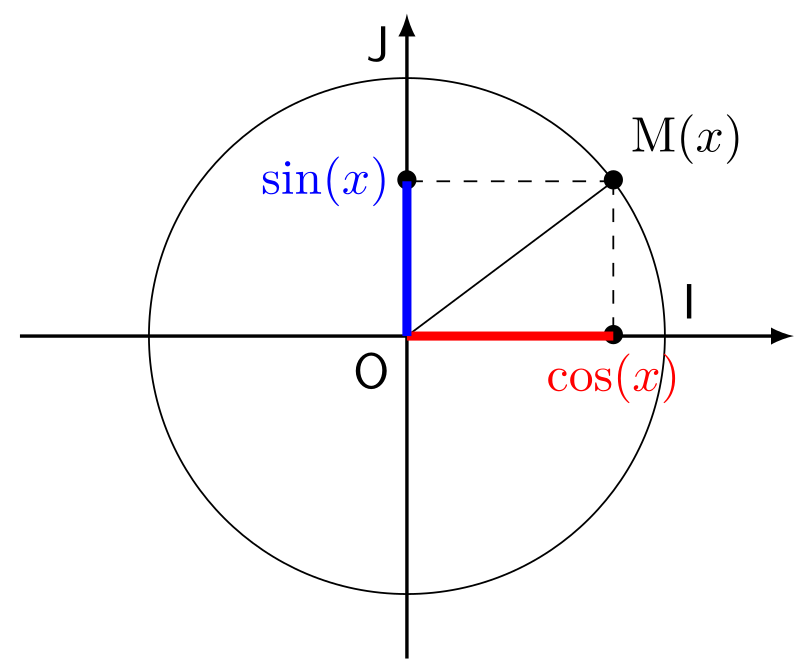
Le cosinus de $x$, noté $\cos (x)$, est l'abscisse du point $\mathrm{M}$.
Le sinus de $x$, noté $\sin (x)$, est l'ordonnée du point $\mathrm{M}$.
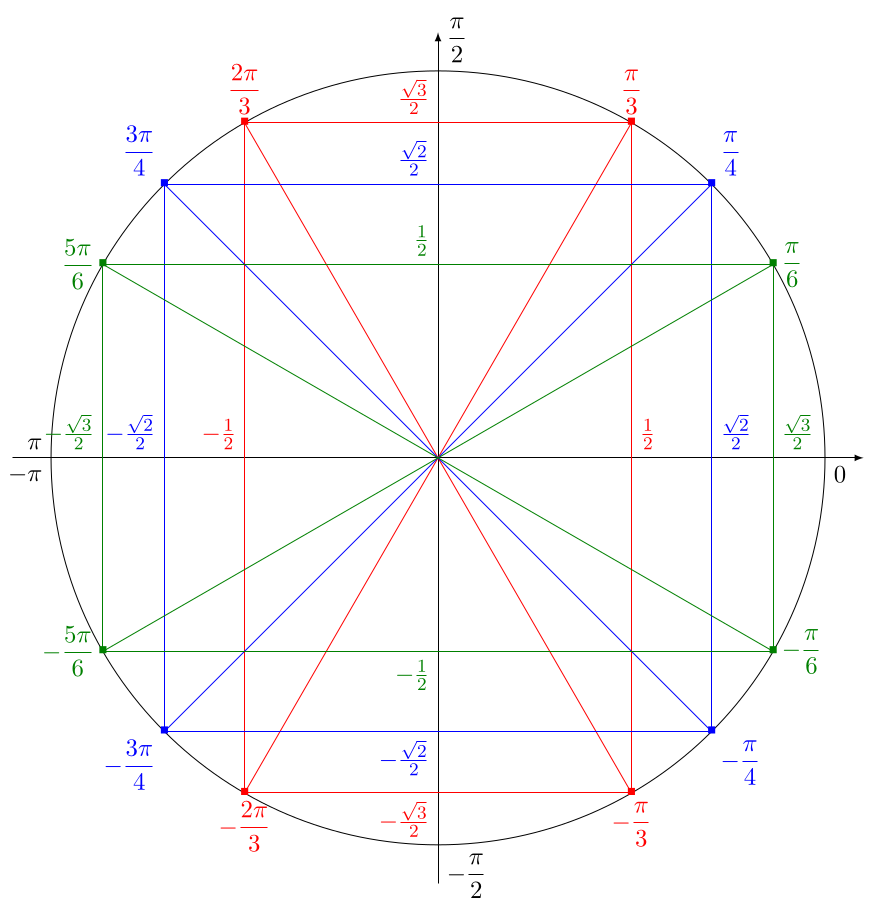
Valeurs remarquables
| $x$ | $0$ | $\dfrac{\pi}{6}$ | $\dfrac{\pi}{4}$ | $\dfrac{\pi}{3}$ | $\dfrac{\pi}{2}$ | $\pi$ |
| $\cos(x)$ | 1 | $\dfrac{\sqrt{3}}{2}$ | $\dfrac{\sqrt{2}}{2}$ | $\dfrac{1}{2}$ | $0$ | $-1$ |
| $\sin(x)$ | $0$ | $\dfrac{1}{2}$ | $\dfrac{\sqrt{2}}{2}$ | $\dfrac{\sqrt{3}}{2}$ | $1$ | $0$ |
Propriétés de base
Pour tout $x\in\mathbb{R}$ on a :
$-1\leq \cos(x)\leq 1\text{ et }-1\leq \sin(x)\leq 1$
Pour tout $x\in\mathbb{R}$ et tout $k\in\mathbb{Z}$ on a :
$\cos(x+k\times 2\pi)=\cos(x)\text{ et }\sin(x+k\times 2\pi)=\sin(x)$
Pour tout $x\in\mathbb{R}$ on a :
$\cos^2(x)+\sin^2(x)=1$
Remarque
La notation $\cos^2(x)$ est une notation abrégée pour $(\cos(x))^2$, de même $\sin^2(x)=(\sin(x))^2$.